在c#中判断一个类型是值类型还是引用类型,最直接且准确的方法是使用 type.isvaluetype 属性。该属性返回一个布尔值:若为 true 则表示该类型是值类型(如结构体、枚举或基础数值类型),若为 false 则表示它是引用类型(如类、接口、数组或委托)。需要注意的是,此方法仅针对类型本身进行静态判断,不涉及运行时对象的装箱或拆箱行为。

如何通过反射获取类型的分类信息?
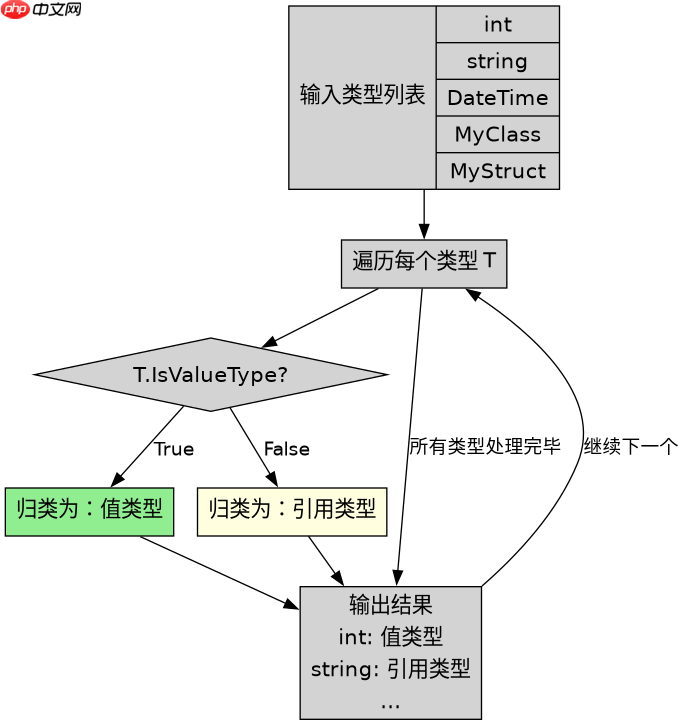
通过反射机制获取类型后,调用 IsValueType 属性即可区分。对于泛型类型参数,必须使用 GetGenericArguments() 提取实际类型后再判断,否则直接对泛型定义判断会返回 false。以下代码展示了如何遍历一组类型并输出其分类结果。

using System;
using System.Reflection;

public class TypeChecker
{
    public static void Main()
    {
        // 定义测试类型
        Type[] types = new Type[]
        {
            typeof(int),           // 值类型
            typeof(string),        // 引用类型
            typeof(System.DateTime), // 值类型
            typeof(MyClass),       // 引用类型
            typeof(MyStruct)       // 值类型
        };

        foreach (Type t in types)
        {
            bool isValue = t.IsValueType;
            string category = isValue ? "值类型" : "引用类型";
            Console.WriteLine($"{t.Name}: {category}");
        }
    }
}

public class MyClass { }
public struct MyStruct { }
运行上述代码将输出:
int: 值类型
string: 引用类型
DateTime: 值类型
MyClass: 引用类型
MyStruct: 值类型
这验证了 IsValueType 能正确识别基础类型、自定义类和结构体。
如何处理泛型类型中的值/引用判断?
在处理泛型时,如果直接对泛型类型参数 T 调用 typeof(T).IsValueType,在某些场景下可能无法获得预期结果,特别是当 T 是未绑定的泛型定义时。正确的做法是先获取泛型实参的具体类型,再对该具体类型进行判断。例如,在解析 List<int></int> 时,需先获取其泛型参数 int,再判断 int 是否为值类型。

using System;
using System.Collections.Generic;
using System.Reflection;

public class GenericTypeChecker
{
    public static void CheckGenericType(Type genericType)
    {
        if (genericType.IsGenericType)
        {
            // 获取泛型实参
            Type[] args = genericType.GetGenericArguments();
            foreach (Type arg in args)
            {
                bool isVal = arg.IsValueType;
                Console.WriteLine($"泛型参数 {arg.Name} 是{(isVal ? "值" : "引用")}类型");
            }
        }
        else
        {
            bool isVal = genericType.IsValueType;
            Console.WriteLine($"非泛型类型 {genericType.Name} 是{(isVal ? "值" : "引用")}类型");
        }
    }

    public static void Main()
    {
        CheckGenericType(typeof(List<int>));   // List<int> 是引用类型,但其泛型参数 int 是值类型
        CheckGenericType(typeof(Dictionary<string, double>)); // 键和值的类型判断
        CheckGenericType(typeof(string));       // 普通引用类型
    }
}
运行结果如下:
泛型参数 Int32 是值类型
泛型参数 String 是引用类型
泛型参数 Double 是值类型
string 是引用类型
这表明在处理泛型容器时,需要深入其泛型参数内部才能准确判断元素类型是值还是引用。
Nullable 类型的 IsValueType 返回值是什么?
对于可空值类型 Nullable<t></t>(即 T?),IsValueType 属性始终返回 true。这是因为 Nullable<t></t> 本身是一个结构体(值类型),尽管它在语义上可以表示 null。这是 C# 类型系统中的一个特例,开发者在判断时应意识到这一点,避免误以为可空类型属于引用类型。
using System;

public class NullableChecker
{
    public static void Main()
    {
        Type nullableInt = typeof(Nullable<int>);
        Type intType = typeof(int);

        Console.WriteLine($"Nullable<int>.IsValueType: {nullableInt.IsValueType}"); // True
        Console.WriteLine($"int.IsValueType: {intType.IsValueType}");                 // True

        // 注意:Nullable<T> 是值类型,但它可以包含 null
        // 如果需要判断是否“可能为null”,应检查 Type.IsGenericType && Type.GetGenericTypeDefinition() == typeof(Nullable<>)
    }
}
输出结果为:
Nullable
int.IsValueType: True
这说明 Nullable<t></t> 在 CLR 层面仍被视为值类型,其“可空”特性是通过结构体内部的标志位实现的,而非引用类型的 null 引用。