子网掩码的选型核心在于根据实际主机数量需求,选择能容纳所有设备且浪费最少的cidr前缀长度。具体做法是确定最大子网的主机数n,计算满足 2^(32-prefix) - 2 ≥ n 的最小prefix值,并据此生成对应的点分十进制掩码。这样做可以确保ip地址空间的高效利用,避免地址耗尽或广播风暴。

如何根据主机数量确定最小前缀长度
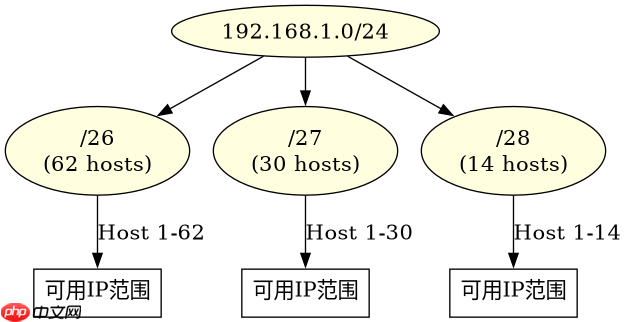
要确定最小前缀长度,需先统计该子网内必须连接的设备总数(包括网关和服务器),然后找到满足 2^h - 2 ≥ 设备数 的最小整数h(主机位)。前缀长度即为 32 - h。例如,若需连接50台主机,则需6位主机位(2^6-2=62≥50),前缀长度为/26。
import ipaddress

def calculate_subnet(hosts_needed):
    if hosts_needed <= 0:
        return None
    host_bits = 1
    while (2 ** host_bits - 2) < hosts_needed:
        host_bits += 1
    prefix_len = 32 - host_bits
    mask = ipaddress.IPv4Network(f'0.0.0.0/{prefix_len}').netmask
    return {
        'hosts_needed': hosts_needed,
        'host_bits': host_bits,
        'prefix_length': f'/{prefix_len}',
        'subnet_mask': str(mask),
        'usable_hosts': 2 ** host_bits - 2
    }

# 示例:需要50个可用IP
result = calculate_subnet(50)
print(result)
运行上述代码,输入50时,程序会计算出需要6位主机位,前缀为/26,掩码为255.255.255.192,可用主机数为62。这验证了/26是满足50台主机需求的最小前缀长度。
如何在VLSM中分配连续地址块
在可变长子网掩码(VLSM)场景中,应从需求最大的子网开始分配,依次递减,以确保地址块的连续性和紧凑性。具体做法是将基网络按需求降序排序,逐个截取所需大小的子网,并记录起始和结束地址。这样可以避免地址碎片化,提高利用率。

import ipaddress

def vlsm_allocation(base_network_str, subnets_needed):
    # subnets_needed: list of dicts with 'name' and 'hosts'
    base_network = ipaddress.IPv4Network(base_network_str)
    allocated = []
    current_net = base_network

    # Sort by hosts needed descending
    sorted_subnets = sorted(subnets_needed, key=lambda x: x['hosts'], reverse=True)

    for subnet in sorted_subnets:
        hosts = subnet['hosts']
        host_bits = 1
        while (2 ** host_bits - 2) < hosts:
            host_bits += 1
        prefix = 32 - host_bits

        try:
            new_net = ipaddress.IPv4Network(f'{current_net.network_address}/{prefix}')
            if new_net.overlaps(current_net) or new_net.subnet_of(current_net):
                # Move to next available block
                current_net = ipaddress.IPv4Network(f'{new_net.broadcast_address + 1}/32')
                new_net = ipaddress.IPv4Network(f'{current_net.network_address}/{prefix}')

            allocated.append({
                'name': subnet['name'],
                'network': str(new_net),
                'mask': str(new_net.netmask),
                'broadcast': str(new_net.broadcast_address),
                'usable_range': f'{new_net.network_address + 1} - {new_net.broadcast_address - 1}'
            })
            current_net = ipaddress.IPv4Network(f'{new_net.broadcast_address + 1}/32')
        except ValueError as e:
            print(f"Error allocating {subnet['name']}: {e}")
            break

    return allocated

# 示例:从192.168.1.0/24中分配
subnets = [
    {'name': 'LAN1', 'hosts': 50},
    {'name': 'LAN2', 'hosts': 20},
    {'name': 'WAN', 'hosts': 2}
]

results = vlsm_allocation('192.168.1.0/24', subnets)
for r in results:
    print(r)
运行此代码,首先分配LAN1(/26),占用192.168.1.0-192.168.1.63;接着分配LAN2(/27),占用192.168.1.64-192.168.1.95;最后分配WAN(/30),占用192.168.1.96-192.168.1.99。这种分配方式确保了地址块的连续和无冲突。
当主机数恰好为2^n-2时掩码是否最优
当主机数恰好等于 2^h - 2 时,使用对应的前缀长度 / (32-h) 是最优的,因为此时没有地址浪费。如果主机数略小于该值,仍应使用该前缀,除非有严格的地址节约需求且允许更小的子网组合。例如,30台主机需5位主机位(2^5-2=30),前缀/27正好容纳30台,无浪费,是最优解。