在python中通过置换检验验证特征重要性的统计显著性,核心做法是构建一个零分布:多次随机打乱目标变量(或残差),重新训练模型并记录每次的特征重要性,将原始数据得到的真实重要性与该零分布进行比较,计算p值。具体实现时,需固定随机种子以保证可复现性,使用`sklearn.inspection.permutation_importance`进行单次评估,或通过自定义循环生成完整的置换分布,最终筛选出p值小于显著性水平(如0.05)的特征。

如何使用scikit-learn内置函数快速评估单个特征的重要性
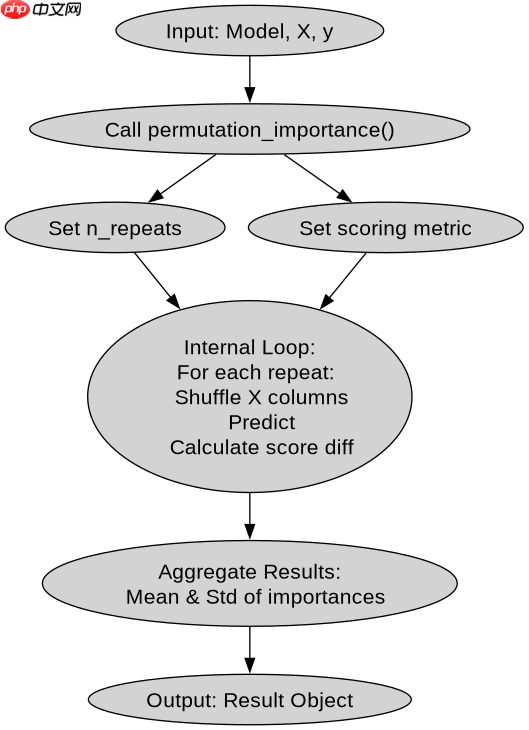
使用`sklearn.inspection.permutation_importance`可以方便地获取特征重要性及其置信区间,该函数默认执行多次置换以提供统计稳定性。它返回的是一个包含均值和标准差的字典结构,适合快速探索性分析。对于每个特征,它会计算置换前后模型性能下降的幅度,从而量化该特征对模型的贡献。这种方法不需要手动编写循环,代码简洁且经过充分测试。
import numpy as np
from sklearn.datasets import make_classification
from sklearn.ensemble import RandomForestClassifier
from sklearn.inspection import permutation_importance

# 生成示例数据
X, y = make_classification(n_samples=100, n_features=5, n_informative=3, random_state=42)
model = RandomForestClassifier(n_estimators=10, random_state=42)
model.fit(X, y)

# 执行置换检验
result = permutation_importance(model, X, y, n_repeats=10, random_state=42, scoring='accuracy')

# 打印结果
for i in range(X.shape[1]):
    print(f'Feature {i}: Mean Importance={result.importances_mean[i]:.4f}, Std={result.importances_std[i]:.4f}')
如何自定义循环构建完整的置换分布以计算精确P值
为了获得更严格的统计显著性检验,需要手动构建置换分布并计算P值。这涉及重复以下步骤:打乱目标变量y,训练模型,计算所有特征的重要性,并将原始重要性作为参考点。通过比较原始重要性在置换分布中的位置,可以计算出经验P值。这种方法允许我们直接观察零假设下的分布形态,并识别出哪些特征的重要性显著高于随机噪声。虽然计算成本较高,但提供了更详细的统计洞察。

Nodriver是Undetected-Chromedriver的官方继承者,提供异步浏览器自动化功能,可直接与Chrome DevTools Protocol通信,无需Selenium或WebDriver依赖。专为规避反机器人系统(包括Cloudflare和Imperva)的隐蔽网络自动化而构建。
立即学习“Python免费学习笔记(深入)”;

import numpy as np
from sklearn.datasets import make_classification
from sklearn.ensemble import RandomForestClassifier
from sklearn.metrics import accuracy_score

# 生成示例数据
X, y = make_classification(n_samples=100, n_features=5, n_informative=3, random_state=42)
model = RandomForestClassifier(n_estimators=10, random_state=42)
model.fit(X, y)

# 计算原始重要性
original_scores = []
for feature_idx in range(X.shape[1]):
    X_permuted = X.copy()
    np.random.shuffle(X_permuted[:, feature_idx])
    preds = model.predict(X_permuted)
    original_scores.append(1 - accuracy_score(y, preds))

# 构建置换分布
n_repeats = 100
permutation_distributions = [[] for _ in range(X.shape[1])]

for _ in range(n_repeats):
    y_permuted = y.copy()
    np.random.shuffle(y_permuted)
    model_perm = RandomForestClassifier(n_estimators=10, random_state=42)
    model_perm.fit(X, y_permuted)

    for feature_idx in range(X.shape[1]):
        X_permuted = X.copy()
        np.random.shuffle(X_permuted[:, feature_idx])
        preds = model_perm.predict(X_permuted)
        perm_score = 1 - accuracy_score(y_permuted, preds)
        permutation_distributions[feature_idx].append(perm_score)

# 计算P值
p_values = []
for feature_idx in range(X.shape[1]):
    dist = permutation_distributions[feature_idx]
    p_value = (sum(1 for s in dist if s >= original_scores[feature_idx]) + 1) / (n_repeats + 1)
    p_values.append(p_value)

print('P-values:', p_values)
当特征间存在高度相关性时置换检验会得出什么结论
当特征之间存在高度相关性时,置换检验可能会低估某些相关特征的重要性,因为打乱其中一个特征并不会显著降低模型性能,模型可以利用其他相关特征进行预测。这种情况下,P值可能不显著,即使该特征在生物学或业务意义上很重要。为了解决这个问题,可以考虑使用基于树的模型自带的特征重要性,或者采用分组置换的方法,即同时打乱一组相关的特征。此外,还可以结合领域知识来解释结果,避免仅依赖统计显著性做出决策。