在python中使用scikit-learn的pipeline可以封装特征预处理与建模步骤,通过实例化`sklearn.pipeline.pipeline`类并传入包含转换器(transformer)和估计器(estimator)的有序列表来实现。这样做能确保训练集和测试集的数据处理逻辑完全一致,避免数据泄露,同时简化了模型保存、加载以及超参数调用的流程。

如何构建包含多步转换器的Pipeline
构建Pipeline的核心在于定义一个由元组组成的列表,每个元组包含名称和对应的对象。对于数值型缺失值,可以使用`SimpleImputer`进行填充;对于类别型特征,通常需要先进行编码处理。将这些步骤按顺序排列后,传递给Pipeline构造函数,即可得到一个集成了所有预处理逻辑的对象。
from sklearn.pipeline import Pipeline
from sklearn.impute import SimpleImputer
from sklearn.preprocessing import StandardScaler, OneHotEncoder
from sklearn.compose import ColumnTransformer
from sklearn.linear_model import LogisticRegression
import pandas as pd

# 假设df是包含数值和类别特征的DataFrame
numeric_features = ['age', 'income']
categorical_features = ['city', 'education']

numeric_transformer = Pipeline(steps=[
    ('imputer', SimpleImputer(strategy='median')),
    ('scaler', StandardScaler())
])

categorical_transformer = Pipeline(steps=[
    ('imputer', SimpleImputer(strategy='most_frequent')),
    ('encoder', OneHotEncoder(handle_unknown='ignore'))
])

preprocessor = ColumnTransformer(
    transformers=[
        ('num', numeric_transformer, numeric_features),
        ('cat', categorical_transformer, categorical_features)
    ]
)

full_pipeline = Pipeline(steps=[
    ('preprocessor', preprocessor),
    ('classifier', LogisticRegression())
])

# 使用示例数据拟合
X_train = pd.DataFrame({'age': [25, None, 30], 'income': [50000, 60000, None], 'city': ['A', 'B', 'A'], 'education': ['High', 'Low', 'High']})
y_train = [0, 1, 0]

full_pipeline.fit(X_train, y_train)
print("Pipeline fitted successfully.")
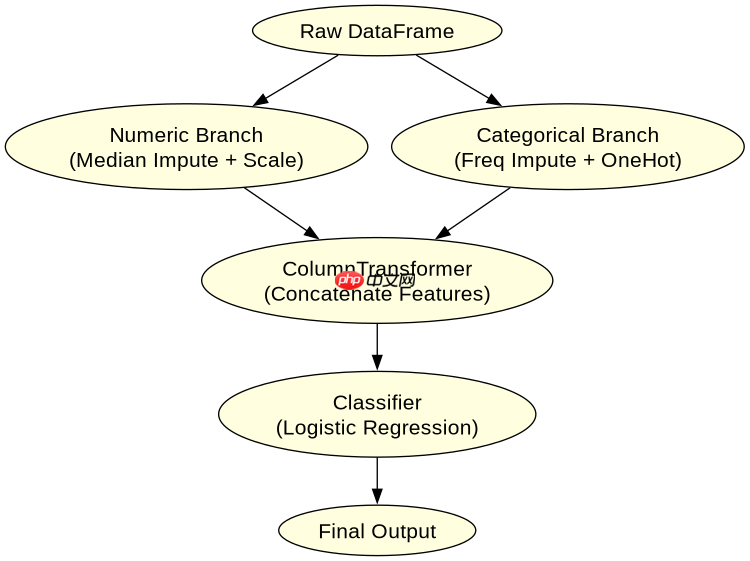
上述代码展示了如何结合ColumnTransformer处理混合类型数据。首先定义数值型和类别型的独立处理流水线,然后将其整合进ColumnTransformer,最后将预处理模块与分类器组合成完整的Pipeline。调用fit方法时,数据会依次经过各个步骤的处理,最终进入分类器进行训练。
立即学习“Python免费学习笔记(深入)”;

QA 集成测试全流程编排器:统筹 service-deployer / test-plan-writer / diff-executor-and-analyzer / data-filter-executor / case-generator / regression-executor-and-analyzer 子 Skill,完成从服务部署到回归测试的全流程。
如何利用GridSearchCv进行端到端超参数搜索
Pipeline的一个显著优势是与GridSearchCV完美兼容。在进行网格搜索时,可以直接访问Pipeline内部各步骤的参数。参数名的命名规则为“步骤名__参数名”,这种双下划线的语法允许开发者同时优化预处理策略和模型超参数,无需手动拆分或重组数据流。

from sklearn.model_selection import GridSearchCV

param_grid = {
    'preprocessor__num__imputer__strategy': ['mean', 'median'],
    'preprocessor__cat__encoder__drop': [None, 'first'],
    'classifier__C': [0.1, 1.0, 10.0]
}

grid_search = GridSearchCV(full_pipeline, param_grid, cv=3, scoring='accuracy')
grid_search.fit(X_train, y_train)

print(f"Best parameters: {grid_search.best_params_}")
print(f"Best score: {grid_search.best_score_}")
在GridSearchCV中,通过双下划线指定参数路径,例如`preprocessor__num__imputer__strategy`指向数值预处理中的插补策略。这使得搜索空间覆盖了从数据清洗到模型训练的各个环节。执行fit后,GridSearchCV会自动遍历所有参数组合,并在每次迭代中重新运行整个Pipeline,从而找到最优的配置方案。
当输入数据缺少某列时会发生什么
如果输入数据缺少Pipeline中定义的某一列,且该列未被显式指定为可选,Pipeline通常会抛出异常。这是因为ColumnTransformer和内部的转换器期望特定的列名存在。为了增强鲁棒性,可以在ColumnTransformer中设置`remainder='drop'`来忽略未指定的列,或者在预处理前对数据进行校验。若某列在训练集中存在但在预测时缺失,SimpleImputer等转换器可能无法正确映射列索引,导致形状不匹配错误。