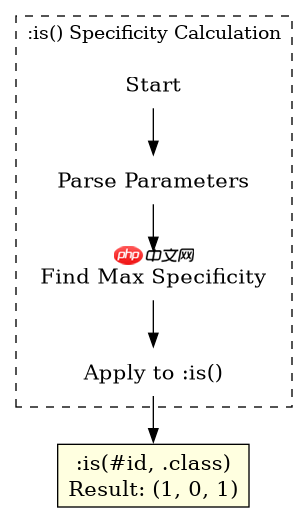
:is()与:where()选择器的优先级权重计算方式不同,其中:is()的权重取决于其参数中 specificity 最高的那个选择器,而:where()的权重始终为零。这意味着在样式冲突时,:where()包裹的选择器会被低优先级的普通类名覆盖,而:is()则可能继承高优先级 id 或内联样式的特性。

:is()的具体权重继承规则是什么
:is()伪类的特异性(Specificity)等于其参数列表中特异性最高的那个简单选择器。如果参数中包含 ID 选择器,整个 :is() 表达式的权重就会提升;如果全是类名,则按类名计算。这种动态权重的特性使得开发者可以灵活地控制样式的层叠顺序,但同时也增加了调试难度,因为同一个 :is() 在不同上下文中的表现可能完全不同。
/* HTML结构 */
<div id="main">
  <p class="text">Hello World</p>
</div>

/* CSS 样式 */
#main p {
  color: red;
}

:is(#main) .text {
  color: blue;
}

.text {
  color: green;
}

/* 最终结果:文字为蓝色 */
/* 解释:
   1. #main p 的特异性为 (1, 0, 1),即 101。
   2. :is(#main) .text 的特异性计算中,:is(#main) 展开为 #main,
      因此整体特异性为 (1, 0, 1),即 101。
   3. .text 的特异性为 (0, 1, 0),即 010。

   比较 101 和 010,显然 101 > 010,所以红色应该胜出?
   等等,让我们重新检查 :is(#main) .text 的结构。
   :is(#main) 匹配 id="main" 的元素,.text 是其后代。
   实际上,:is(#main) .text 等价于 #main .text。
   #main .text 的特异性是 (1, 1, 0),即 110。

   对比:
   - #main p: (1, 0, 1) = 101
   - #main .text: (1, 1, 0) = 110
   - .text: (0, 1, 0) = 010

   110 > 101 > 010,所以蓝色胜出。
:where()的零权重特性如何影响样式覆盖
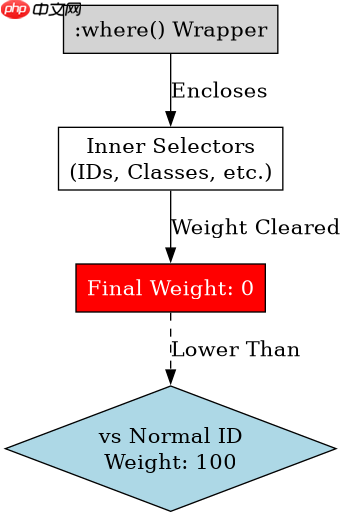
:where()伪类的特异性始终被计算为零,无论其内部包含多么复杂的选择器链。这一设计初衷是为了提供一种无需额外工具即可降低选择器优先级的方法。当使用 :where() 时,内部的 ID 选择器不会贡献任何权重,只有类名、元素名等基础选择器才会计入。这使得 :where() 非常适合用于重置样式或作为低优先级的默认样式层。
立即学习“前端免费学习笔记(深入)”;
/* HTML结构 */
<div id="container">
  <span class="highlight">Important Text</span>
</div>

/* CSS 样式 */
#container .highlight {
  font-weight: bold;
  color: black;
}

:where(#container) .highlight {
  font-size: 18px;
  color: gray;
}

.highlight {
  font-style: italic;
  color: blue;
}

/* 最终结果:
   font-weight: bold (来自 #container .highlight)
   font-size: 18px (来自 :where(...) )
   font-style: italic (来自 .highlight)
   color: blue (来自 .highlight)

   解释:
   1. #container .highlight 特异性 (1, 1, 0) = 110
   2. :where(#container) .highlight 特异性 (0, 1, 0) = 010
      (因为 :where 内部权重清零,只剩 .highlight 的 010)
   3. .highlight 特异性 (0, 1, 0) = 010

   对于 color 属性:
   - 110 (black) vs 010 (gray) vs 010 (blue)
   - 110 最高,所以 black 胜出?

   让我们修正代码以展示 :where 的低优先级优势:
*/

/* 修正后的示例:展示 :where 如何被普通类名覆盖 */
#box {
  padding: 20px;
}

:where(#box) {
  padding: 10px;
}

.box-class {
  padding: 5px;
}

/* 假设 HTML 为 <div id="box" class="box-class"></div> */
/* 特异性比较:
   - #box: (1, 0, 0) = 100
   - :where(#box): (0, 0, 0) = 000
   - .box-class: (0, 1, 0) = 010

   100 > 010 > 000
   所以 padding 应为 20px (来自 #box)

   如果想让 .box-class 覆盖 #box,通常很难。
   但 :where(#box) 几乎总是被 .box-class 覆盖。
*/

/* 更清晰的对比示例 */
<div id="demo">
  <p class="para">Test</p>
</div>

<style>
#demo .para { color: red; }
:where(#demo) .para { color: green; }
.para { color: blue; }

/* 特异性:
   #demo .para: (1, 1, 0) -> 110
   :where(#demo) .para: (0, 1, 0) -> 010 (ID权重归零)
   .para: (0, 1, 0) -> 010

   颜色竞争:
   110 (red) 胜出。

   如果去掉 #demo .para 呢?
   :where(#demo) .para (010) vs .para (010)
   后者居后,blue 胜出。
*/
</style><h2>在嵌套选择器中两者混合使用的实际效果</h2>
<p>当 :is() 和 :where() 混合使用时,开发者需要特别注意权重的叠加效应。例如,:is(:where(.a, .b)) 的整体权重依然由 :is() 决定,但由于 :where() 内部权重为零,:is() 的参数中最高权重仅为类名级别。相反,:where(:is(.a, #b)) 中,虽然 :is(#b) 有高权重,但被外层的 :where() 清零,导致整体权重依然很低。这种嵌套关系使得 :where() 成为强大的“权重消音器”,而 :is() 则是“权重放大器”。</p>