在python中使用pytorch进行模型推理时,通过调用 torch.no_grad() 上下文管理器可以显著减小内存占用。该操作会禁用梯度计算,从而避免为输入张量及其衍生中间结果分配用于反向传播的内存空间,同时减少显存峰值并提升推理速度。

如何验证无梯度模式下的内存节省效果
要直观看到 torch.no_grad() 的效果,可以通过对比开启和关闭梯度记录时的显存使用量来验证。在正常训练模式下,PyTorch 会为每个参与计算的张量保存历史操作以构建计算图,这会导致内存随网络深度线性增长。而在推理场景下,我们只需要前向传播的结果,不需要保留这些历史数据。

import torch
import torch.nn as nn

class SimpleModel(nn.Module):
    def __init__(self):
        super(SimpleModel, self).__init__()
        self.fc = nn.Linear(1000, 500)
        self.relu = nn.ReLU()
        self.out = nn.Linear(500, 10)

    def forward(self, x):
        x = self.fc(x)
        x = self.relu(x)
        return self.out(x)

model = SimpleModel()
x = torch.randn(32, 1000) # Batch size 32, input dim 1000

# 记录初始显存
torch.cuda.empty_cache()
initial_memory = torch.cuda.memory_allocated() / 1024**2

# 开启梯度计算(模拟训练或默认行为)
with torch.enable_grad():
    y_grad = model(x)
    memory_with_grad = torch.cuda.memory_allocated() / 1024**2

# 关闭梯度计算(推理模式)
with torch.no_grad():
    y_no_grad = model(x)
    memory_without_grad = torch.cuda.memory_allocated() / 1024**2

print(f"Initial Memory: {initial_memory:.2f} MB")
print(f"Memory with grad: {memory_with_grad:.2f} MB")
print(f"Memory without grad: {memory_without_grad:.2f} MB")
print(f"Saved: {memory_with_grad - memory_without_grad:.2f} MB")
运行上述代码,你会发现 memory_with_grad 远大于 memory_without_grad。这是因为 y_grad 关联了计算图,而 y_no_grad 只是一个普通的张量。对于大型模型,这种差异可能达到数GB。
立即学习“Python免费学习笔记(深入)”;

Nodriver是Undetected-Chromedriver的官方继承者,提供异步浏览器自动化功能,可直接与Chrome DevTools Protocol通信,无需Selenium或WebDriver依赖。专为规避反机器人系统(包括Cloudflare和Imperva)的隐蔽网络自动化而构建。
为什么no_grad能减少内存且不影响输出结果
torch.no_grad() 的核心机制是临时将全局标志 torch.autograd.grad_mode.enabled 设置为 False。当这个标志为假时,所有自动求导引擎的操作都会被跳过,张量不再追踪其创建历史。由于推理过程只关心最终的数值输出,而不需要计算损失函数相对于参数的导数,因此丢弃计算图是完全安全的。这不仅节省了存储梯度所需的内存,还因为避免了反向传播图的构建开销,使得前向传播本身也更快。
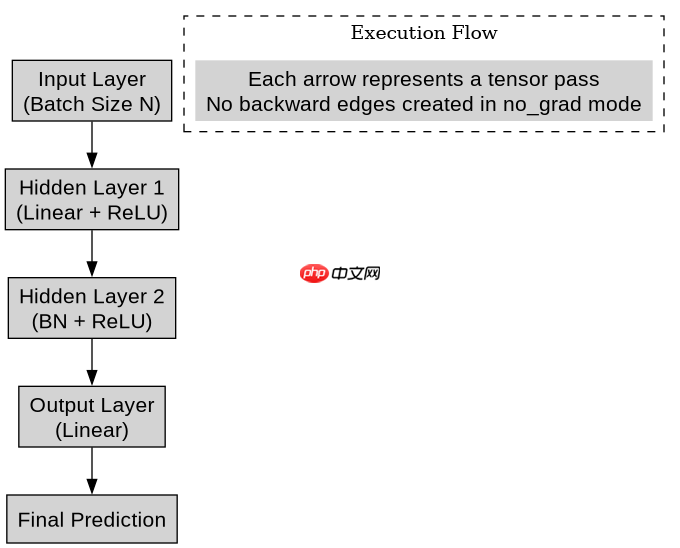
import torch
import torch.nn as nn

class ComplexModel(nn.Module):
    def __init__(self):
        super(ComplexModel, self).__init__()
        self.layers = nn.Sequential(
            nn.Linear(2048, 1024),
            nn.BatchNorm1d(1024),
            nn.ReLU(),
            nn.Linear(1024, 512),
            nn.BatchNorm1d(512),
            nn.ReLU(),
            nn.Linear(512, 10)
        )

    def forward(self, x):
        return self.layers(x)

model = ComplexModel().eval() # 确保BatchNorm等处于评估模式
x = torch.randn(64, 2048)

# 正常模式
out_normal = model(x)
print(f"Normal output shape: {out_normal.shape}")
print(f"Requires grad: {out_normal.requires_grad}")

# no_grad 模式
with torch.no_grad():
    out_inference = model(x)
    print(f"Inference output shape: {out_inference.shape}")
    print(f"Requires grad: {out_inference.requires_grad}")

# 验证数值一致性
torch.testing.assert_close(out_normal, out_inference)
print("Outputs are identical.")
注意,在使用 torch.no_grad() 时,通常建议同时将模型设置为 model.eval() 模式。虽然 no_grad 主要影响梯度计算,但 eval() 会改变 Batch Normalization 和 Dropout 等层的行为,使其使用统计值而非批次统计值,这对于获得正确的推理结果至关重要。两者结合使用是标准的最佳实践。
在动态形状输入下no_grad的表现如何
当处理变长序列或动态批大小的输入时,torch.no_grad() 依然能有效管理内存。关键在于,即使输入形状变化,只要不启用梯度追踪,PyTorch 就不会为这些动态变化的张量维护复杂的依赖关系。这使得在处理不定长数据时,内存分配更加可预测,不会因为偶尔的大批量输入而导致显存瞬间溢出(OOM)。